

Books Need DVD Extras
We should all be Tony Soprano

This past month, I was ill for a week, and so, per my internal rule, I allowed myself to watch The Sopranos. I began watching it for the first time in late 2022 when I had food poisoning in India; three and a half years later, I’m still only halfway through season four.
I’m enjoying taking it ridiculously slowly. With a show like The Sopranos, I’m more interested in plumbing its depths than finding out what happens next. I know how it ends; I don’t live under a rock. But how do we get there? Don’t tell me, but not because I think you’ll spoil it — I just don’t care. Every episode is the same: a group of mobsters, brutal and goofy and often out of their depth, grapples with their internal sense of honor, their selfish desires, and the impact of this work on their loved ones. There’s the perpetual threat of violence and the FBI hovering overhead, but no big mystery propelling us forward. Cliffhangers are rare. It’s not uncommon for an episode to end with Tony and Carmela sitting in the kitchen, Tony eating a sandwich while Carmela flips through the mail. There is simply this life, strange and utterly unique, but life all the same, with mysteries and meaning to be sought out in every moment. Each little detail is thoughtfully placed—the statues in the therapist’s office always change; why? Is there a story behind this song?—and even though there is a clear vision, such textual intricacy often leads to multiple different interpretations of the same thing.
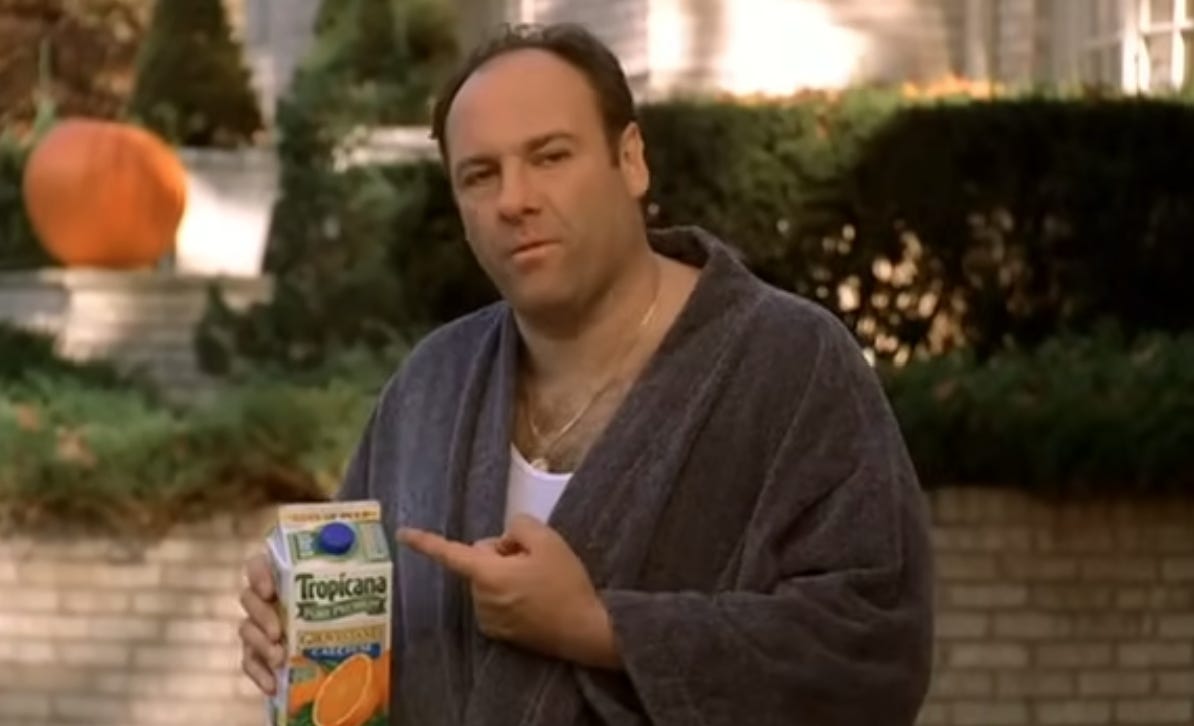
That’s why, after I finish each episode, I scour the internet for analyses and commentary. Even in the worst throes of illness, I never watch more than one episode per day. There wouldn’t be time, I have so many things to read! These analyses themselves draw upon a huge canon of work: post hoc interviews with the writers, director commentaries, deleted scenes, mini-documentaries about the stunt work, costumery, music, and more.
My sick week living in the world of The Sopranos made me nostalgic for this era of DVD extras. They took up a large part of my childhood. You don’t want to know how many hours I spent as a child watching every single bonus feature from the Lord of the Rings trilogy. (Yes, like every other LOTR nerd, I am aware that Viggo Mortensen broke his human toes in the scene where Aragorn kicked a helmet, and so those screams of pain were real, the fall to his knees unscripted.)
But I’ve never seen the DVD extras for The Sopranos. I don’t own a DVD player!1 But I benefit from the fact that these extras exist; they make the discourse surrounding the enterprise more rich and interesting.
What about books?
Why do we not have the same diverse body of work surrounding books? Books are equally full of thought and meaning and tiny details the reader probably won’t notice, maybe a few inside jokes no one will understand. When I finish a book I love, I also scour the internet for reviews and interviews and interpretations. I was excited to finish reading Karl Ove Knausgaard’s School of Night, for instance, just so I could read the reviews by Sam Jennings and Aled Maclean-Jones (here and here).
But that’s not quite the same. Most book “extras,” few though there are, do not actually come from the people involved in the book’s production. The reviewers rarely have the author’s personal insight to guide their review. In a way, they’re taking a shot in the dark. Their reviews can be compelling, of course, but sometimes I learn more about the reviewer’s point of view than the topic at hand. (Which is why there’s a stable of reviewers I’m always excited to read).
As for author interviews out there, they need to appeal equally to people who have and have not already read the book. If anything, they’re geared more towards people who have not. It’s a PR tactic, after all, carried out in hopes of gathering new readers and selling more books. So the authors have to avoid spoilers and tiptoe around important plot points. It’s rare for them to analyze their own work with the same level of depth.2
Some of this might be self-imposed. I think there is a stigma against authors over-analyzing their own work. And some are unwilling to share the secrets of their work. Maybe we all aspire to be David Lynch:
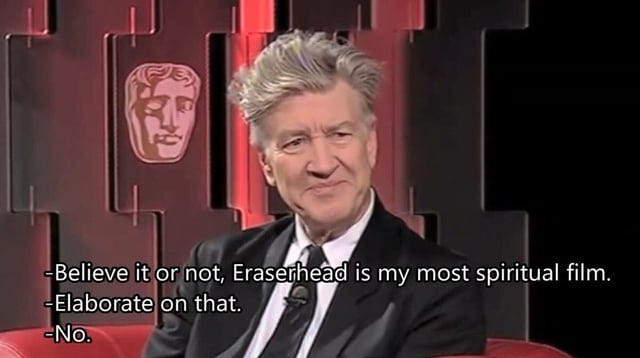
Lynch is gonna Lynch. But in general I want to learn more about an author’s mind. Why else would I read a whole book from their brain?
Who’s afraid of elaboration?
“Show, Don’t Tell” is a rule of writing often attributed to Anton Chekhov, who once said, “Don’t tell me the moon is shining; show me the glint of light on broken glass.”
But Chekhov, I think, didn’t actually mean what people think he meant. He certainly didn’t shy away from narrative exposition. His most famous story, “The Lady with the Dog,” begins: “It was said that a new person had appeared on the sea-front: a lady with a little dog.” And the narrative continues and interjects as the story develops.
The moonlight quote, I think, is just about giving a better visual description, with more meaningful specifics. There’s not just a moon; there’s broken glass nearby, a feeling of destruction that reflects back on the viewer. He was not suggesting replacing narration with visuals altogether.
Regardless, this rule has often been hammered into new writers ever since the mid-1900s, with the rise of Ernest Hemingway and Raymond Carver and the cadre of young writers following in their footsteps; when the American MFA program came to prominence, allowing this mode to be taught on a mass scale (at least anecdotally), and when The New Yorker was changing its style to match. Now, good writing was supposed to never explicate, but be full of secret meanings underneath accessible prose, consisting mostly of actions and dialogue. “Hills Like White Elephants,” with two people talking about a possible abortion without actually talking about it, became a template. As Naomi Kanakia recently put it, “the meaning of the ending [of New Yorker stories] isn’t really spelled out, but only a simpleton wouldn’t get it. That’s what makes the stories so fun! They’re like playing the Wordle: the game feels difficult, but in reality it’s very hard to lose.”3
Yet expositional literature has a much longer history. Since the beginning of literature! In The Iliad, we get pages and pages of soldier and ship names before the battle begins. The most famous book of all time is the Bible, which is ninety percent recapitulation. The great books of the 1800s and early 1900s—Dostoevsky, Dickens, Steinbeck, Wharton, and so on—are teeming with exposition but that does not undercut their depth or greatness. On the contrary!
Things have changed in recent years; MFAs have loosened expectations, and writers feel freer to experiment. And there has remained a strain of writers who overexplain—your Bellows and Roths and DFWs aren’t going away. But there’s still a bias against too much overexplanation that likely carries over to a writer’s thoughts on their own work.
Everything is commentary
Is my desire for more discourse is making your nose bleed? Is everything turning into discourse these days?
No. Everything has always been discourse.
Oral histories precede written stories, even long after writing was invented. Homer’s epics were oral histories for hundreds of years before they were ever written down. It was the same with the Bible until Ezra the Scribe came along; the Gospels were written decades after Jesus’s death. Socrates famously hated books, and his was a common opinion. He believed they made people stupid because they weakened their memories and only gave a superficial appearance of wisdom. And, importantly, Socrates believed that books are incurably static: as time passes, the books fall further away from the present, and therefore become harder to engage with, while knowledge should be an active endeavor, responding to and with the present world.
Socrates was a little silly, but this idea was his silliest. I do agree with his point that books should be dynamic, but I think they inherently are, because life is dynamic. One of the reasons reading the Bible is so fun is because you can take a dozen different meanings from any given passage, and it can offer insight on a current problem or take you away from it or both. In Judaism, we have the Mishnah and the Talmud, which are known as the “Oral Torah” — for centuries, rabbis argued over the meaning and implication of the Bible, and these arguments, again, were only written down later. On top of that there are thousands of commentaries and lectures and books upon books about every story in the Torah you could ever hope to read. The conversation, the dialogue with the text, is the point. Torah means “teaching,” and to teach, you have to engage.
Death of the Death of the Author
But who is the author to say what their own work is about? Maybe they’re wrong? In “The Death of the Author,” Roland Barthes argues that an author’s intention about their work doesn’t matter. Rather, it belongs to the reader. We’ve been marinating in this idea for that past fifty years so much that it’s hard to escape. And it morphed into something more nefarious: Literary quality began to mean the author should disappear from the work.
This brings me to a big difference between books and movies/television shows. Books have one author (usually), while movies and shows have many people involved. Even films that come from a singular vision, like writer/director Paul Thomas Anderson, bring in creative energies from the cinematographer, editor, colorist, and so on. DVD extras from these films would offer multiple different viewpoints, sometimes competing viewpoints, and it’s exciting to see how they fit together. The fact that there is no one vision means there are many possible interpretations and they might all be correct.
But book publication also involves a huge team! Yet you rarely see agents or editors or cover designers talking about the process of a specific book or providing fun anecdotes. Maybe it’s because a book’s author ultimately supersedes the others in their interpretation of the work. They could theoretically provide a “right” or “wrong” answer. If so, that might shut down the discourse rather than open it up?
But I just don’t think this is the case. An author’s personal commentary doesn’t shut down discourse. Maybe there are one or two “secrets” they should keep to themselves. Like the finale of The Sopranos. The showrunner refused to say whether Tony lives or dies. But keeping that secret did not prevent the directors and writers and hundreds of others from analyzing the show as a whole.
Perhaps there is a religious sentiment on why an author should refrain from commenting on their work? Rather than overanalyze themselves, they may wish to hire rabbis to argue and disagree until their arguments become the story. Alas. We don’t all have hundreds of rabbis on retainer. In the meantime, the idea of the death of the author is slowly disappearing, especially in the age of AI, when the human behind the words matters more than ever. Like Cairo Smith said,
Commentary can make you look dumb
There is the unfortunate truth that some artists are not very good at commenting on their own work. Neal Stephenson, for instance, writes huge, wonderful books, but is a terrible public speaker. If you want to understand how he thinks, you really do have to just read the damn thing.
I haven’t seen Stranger Things, but I am aware that people hated the series finale. Like, hated with a burning rage. Twelve days after it wrapped, Netflix released a behind-the-scenes documentary about this final season.
It is… revealing.
In the documentary, we learn that the showrunners didn’t have a script for the final episode when they began shooting the season. There are lots of interviews with people who seem stressed and confused.
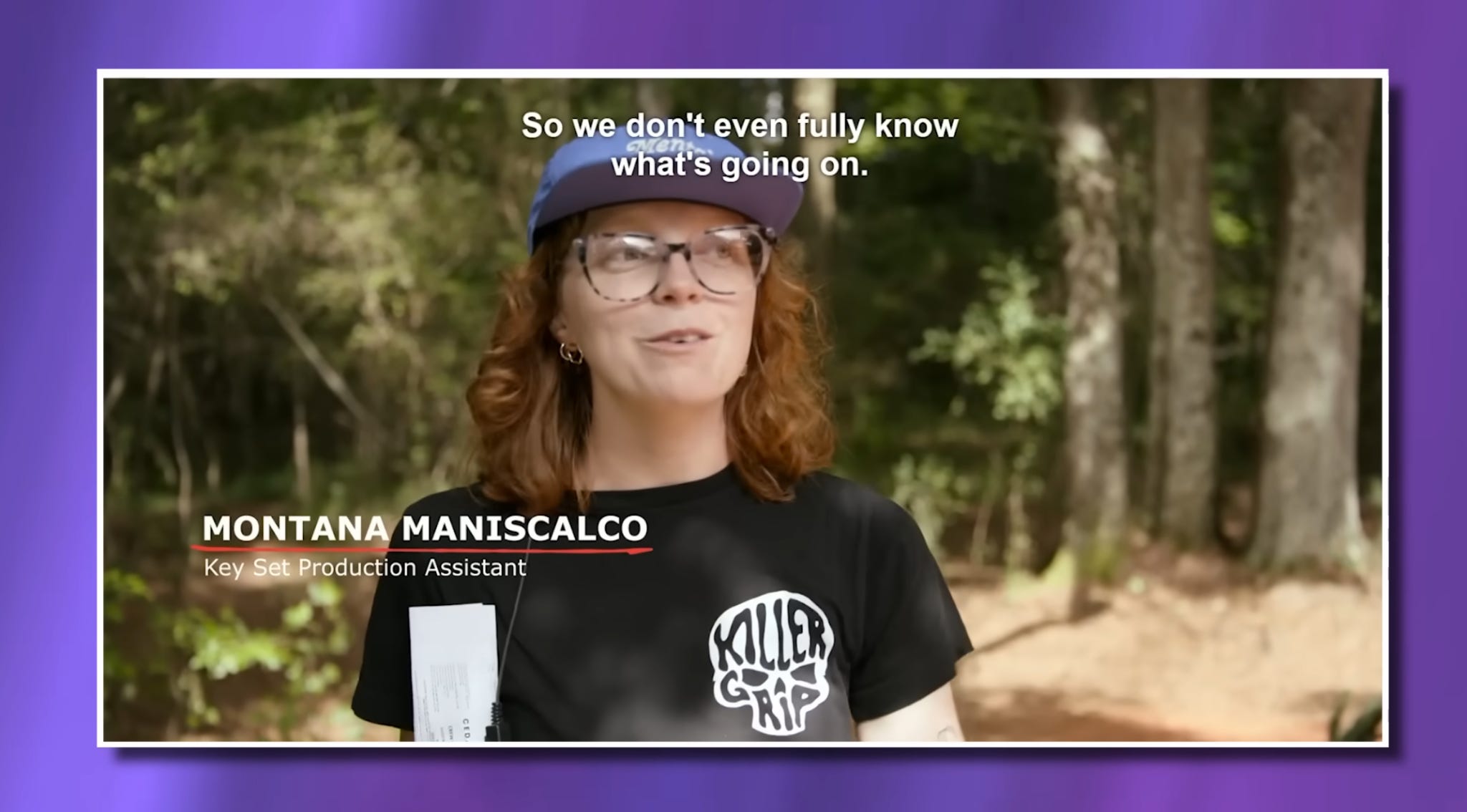
Screenshot from Drew Gooden on Youtube
The directors also admitted that they actually “had no interest in writing at all” — they had fun ideas but didn’t really care about the execution. Their thoughts on what the finale should be include, “the thing that’s cool is the giant monster.”
Netflix recently issued a new policy that they won’t start shooting a new season until all the scripts are written, and it’s very likely because of this debacle.
Why was that not their policy before?
What if we just slowed down?
Would the Stranger Things finale have been better if they had more time and put more thought into it? Is there too much focus on churning out content quickly? Is the fall of “extras” is a casualty of this?
I don’t know, but I’m not here to complain about TV. I’m here to complain about books. Publishers and editors and everyone involved in the process tend to work on twenty books at the same time. It seems like the churn has increased recently but maybe it’s always been this way. Maybe there is no time for the people involved to stop working on new books and focus more on lifting up the ones they already have. Publishing is a “spaghetti-on-the-wall” type of business—publish a lot and hope that one book sells enough to lift up the rest.
But I also think some publishers are putting more pressure on their star authors to write and publish more quickly. For instance, the author of Vera Wong’s Unsolicited Advice for Murderers notes in the acknowledgments that she wrote the book in a one month, after she had sold the idea. (She also notes that the entire second half of the book was written in three days. Three days! Even if that were remotely possible for me, I’d probably never admit a thing like that!)
There are always exceptions
I didn’t set out to write this with the intention of plugging my own book and process, but I think they’re worth highlighting. My publisher, Bindery Books and the imprint Mareas, asked me to think about fun “extras” for The Unmapping from the very beginning. I just didn’t really know where to start.
Still, we were able to do the following:
Published an annotated version of the first chapter, with commentary from both me and Marines Alvarez, who acquired the book. You can read it here!4
Did an interview with audiobook narrator, Julia Whelan, as an exclusive for the the end of the audiobook. In this interview we could go into depth on plot points because by the time a listener gets to that part, they’ve already read the book. (Interview is only available via Audiobrary, where the book can be bought or, gasp, RENTED).
Wrote personal a behind-the-scenes on why the story is set largely in New York City
Did two different Q&A for Marines’s Youtube subscribers (see here and here)
And more things I’m probably forgetting! For instance, we talked about doing an interview with the cover artist, Ibrahim Rayintakath, who is incredible, but that didn’t pan out.
But I understand my case is not at all the norm. And I didn’t go about this in a consistent manner; all these different little pieces live in different places, not in one nice DVD package. (I should probably change that by creating a dedicated webpage or something). (But will I?)
A replacement for book coverage?
With The Washington Post book section now gutted, and book coverage as a whole taking a nosedive many are worried about what comes next. To that I suggest, why shouldn’t authors cover their own books more? I don’t mean sending out advertisements, but instead spending more time analyzing their own work.
Hopefully, authors are already doing this — analyzing their own work. But rarely do these analyses make their way to publication. I again spent hours and hours preparing for interviews and book talks for The Unmapping. I have at least seventy pages of notes! If I had “extras” in mind maybe I would have worked harder to transform those notes into something publicly readable.
And, why not review ourselves? Ben Franklin wrote under a number of pen names to critique issues from a variety of perspectives and respond to fictional letters. Jorge Luis Borges wrote reviews for books that didn’t exist. This could and should involve some experimentation!
I understand why people don’t do this.
When it came to the publication of my first novel, I had no idea if anyone would care about the book. So why would I put in extra work to make something no one would read? I would hate for a new huge realm of self-marketing to become the norm. If an artist wants to work in peace, they should be free to do so.
And I understand an artist’s desire to move on from what they’ve already finished. Eight months post-publication, I’m happy to not think about The Unmapping. Actually, I was ready to move on within a month. I’m fully enveloped in my current book project. Here again I have hundreds of pages of notes that would make no sense to anyone other than me. Maybe I’ll draw upon them one day. But that day is so far away it may as well not exist. Right now, it’s enough to keep going with the story.
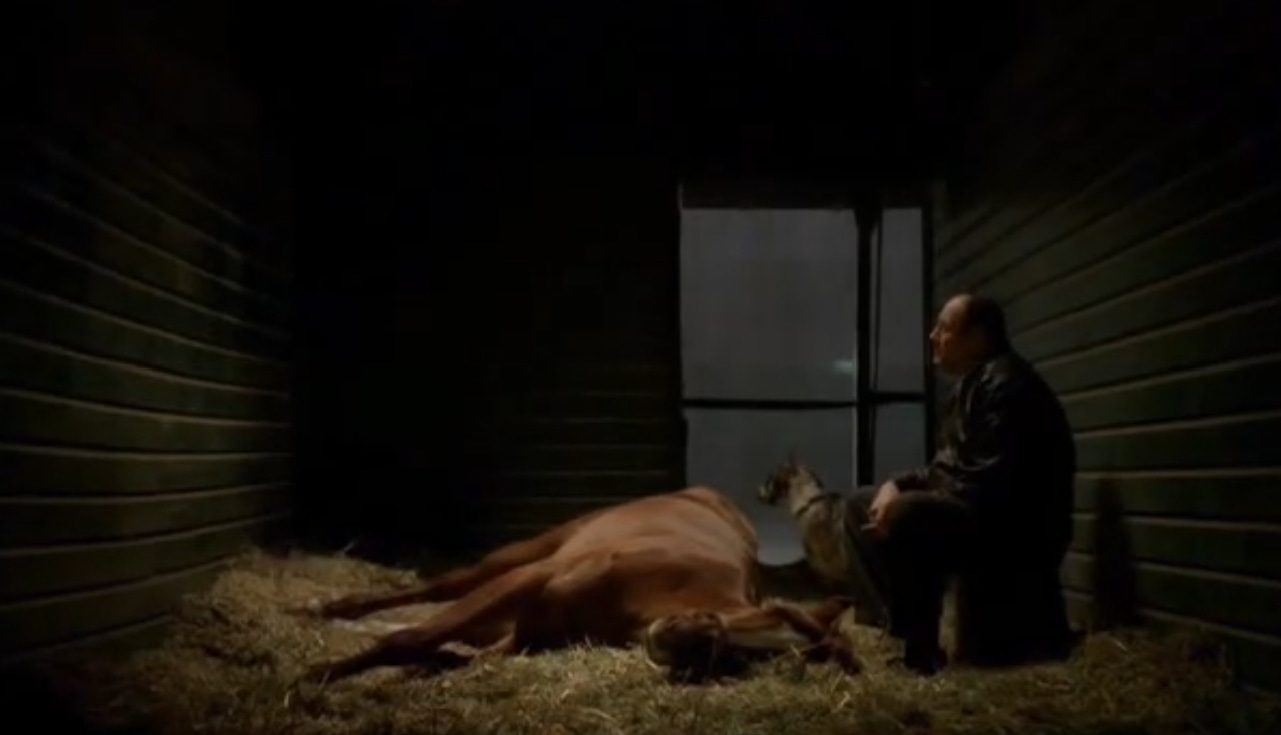
Maybe we don’t need the extras. I don’t need a director’s commentary to be moved by Tony crying over a sick racehorse named Pie-O-My. I don’t need some commentator foreshadowing this horse’s eventual demise. I can simply experience Tony’s world along with him.
But still…
The extras are fun!
And, more importantly, they promote a slower form of engaging with art. An active engagement, when it’s done right. Maybe such engagement can make books exciting again, to generate the same amount of conversation as a new season of a terrible show. More depth, more interpretations, more dialogue.5
To be clear, we don’t need more “content” to be “consumed.” Nobody needed a Colleen Hoover-themed nail polish color.
Rather the opposite. We need each book to matter more, for longer. The more attention you pay to something, the more it grows. Maybe this would help more readers fall in love with their books, and maybe even, by extension, with the world.
The funny thing is, even while the “extras” might serve to expose a story’s construction, they make the dreamworld a little more real. Because it becomes real inside us.
But that’s just my opinion.
-Denise
Postscript: What book “extras” might you like?
I posed this question online and got a couple responses:
Clancy Steadwell offers “behind the scenes” on a chapter-by-chapter basis to his paid subscribers
Futurist Letters publishes short stories and then, behind the paywall, includes a note from the author describing their process, like in this dark and powerful story from Lillian Wang Selonick :

My husband also brought up the “Meow Wolf” museums we’ve visited in Santa Fe and Denver, which are less museums than they are stories brought to life. A single story in each museum, with rooms that you can explore and piece together clues. It’s not like an escape room, there’s no simple problem to solve; rather, these exhibits allow you to make this story fuller and more real. It’s interactive and nonlinear and you get as much out of it as you put in. Part of me thinks this is the future of fiction. But it would be really hard to scale!6
So what’s the answer? What else is possible? What do you think?
I’m not looking for ideas for more content around The Unmapping - as mentioned above, I’m done with that. I’m just curious about what the possibilities are for books as a whole.
This might be for the best—if I had access to director commentaries my pace would significantly slow and I might never finish the series.
I conduct author interviews often and love the form, and I think they have value even with this tiptoeing, but sometimes I wish we could be more open
Husband and I play Wordle every morning and we intentionally make our first two words stupid and unhelpful. “Poopy” is a great bad word, for instance. We still never lose.
Seriously it was an amazing and unique publication process. The people who acquire the books are not editors but accomplished social media creators, who each run their own personal imprints. (The authors all work with contracted editors in addition). They champion their books from acquisition to publication. So I was working with Marines, who knew this book backwards and forwards, and was often more lucid and elegant in talking about it in interviews than I was! This was probably the closest thing to a movie-esque team production that I’ve ever experienced. (Although at the end of the day I still had final word on creative decisions).
Ideally this dialogue is about the story itself, not the metastory of, say, an author possibly gathering more media attention than she deserved, which itself garners attention, a metastory that folds in on itself until it implodes.
Of the two we went to, Denver’s has more impressive art, but Santa Fe’s is much more exciting on a story level. Highly recommend both, though!
an interesting concept and I think something that should be seriously considered in the internet age.
something like a podcast series where a very interested host reads through the book or goes chapter by chapter and then interviews the author and asks them questions and takes live audience ce questions or receives emailed questions from readers could be a fun accompanying thing. I could see myself doing this with my own manuscript someday
The Stranger Things show runners had years to write a decent ending. They weren't rushed.